Working field page
Ageometrics
Ageometrics: Geometric Sufficiency and Residue Analysis studies what a declared geometry preserves, what it erases, and what auxiliary channels restore target-relevant decision value.
Narrative bridge. If a final form is a lossy residue of exploration, Ageometrics asks what the observer can still recover from it. Every assessment is relative to a declared observer, protocol, representation, and target. Similarity is not identity, and sufficiency for one target does not imply a unique history or a complete world model.
Current release posture. Ageometrics is published here as a decision-theoretic working paper with a minimal reproducible illustration, typed residue taxonomy, and an explicit benchmark roadmap. Cross-domain validation, sensitivity analysis, observer-envelope testing, and exhaustive prior-art review remain in progress.
Claim boundary. Same-learner V-GSR holds the declared observer and much of the comparison protocol fixed, but it remains observer- and architecture-relative. Model-envelope views are robustness-oriented, not automatically conservative.
Measurement frame
Declared geometry vs residue vs restore
Minimal reproducible illustration, not broad empirical validation. Comparators keep the claim honest.
Core question
Geometry is one of science's most powerful compressive languages. Coordinates, neighborhoods, symmetries, manifolds, graphs, and topologies can all preserve striking amounts of structure. That success also creates a methodological risk: a useful geometry does not by itself show that the representation preserves everything relevant to a declared task.
Ageometrics asks that narrower question directly.
- How much target-relevant decision value survives compression into a declared geometry?
- How stable is that result across reasonable representations and observer choices?
- What typed residue remains outside the geometric account?
The Geometric Sufficiency Ratio
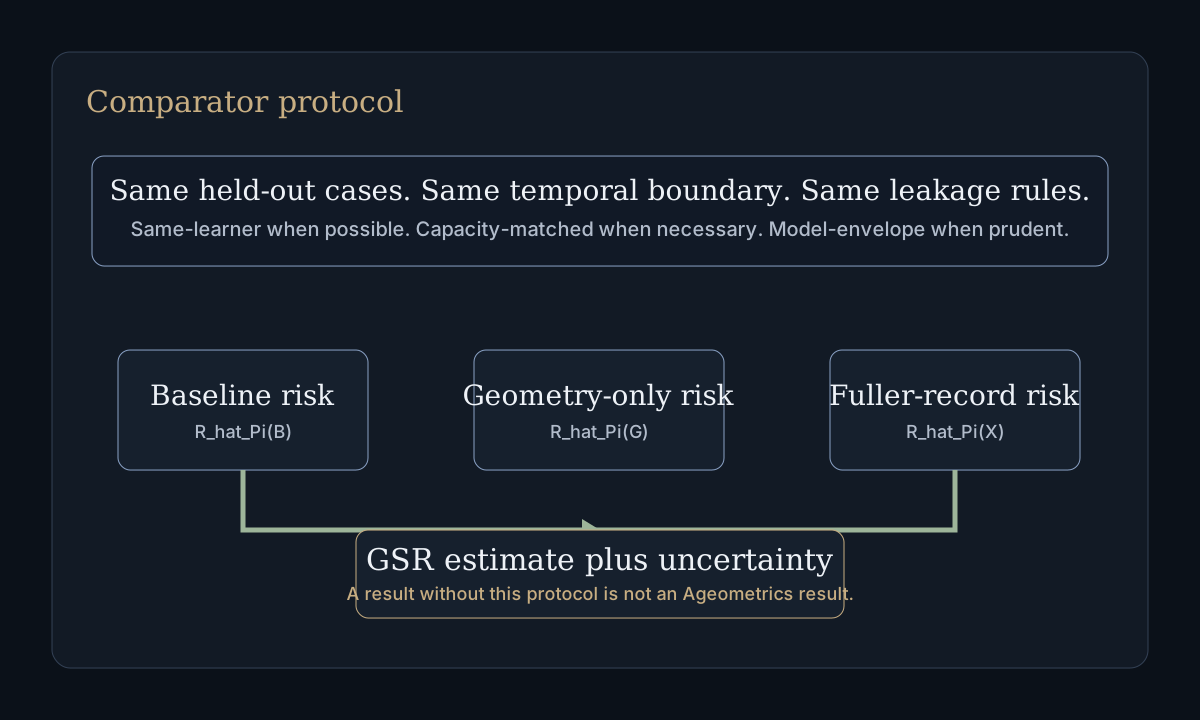
The Geometric Sufficiency Ratio compares prediction from a declared geometric representation with prediction from a declared fuller reference record.
- GSR = 0: the geometry adds nothing beyond baseline.
- GSR = 1: the geometry preserves all target-relevant decision value available from the fuller record.
- 0 < GSR < 1: the geometry is useful for the declared target but incomplete.
The framework also defines observer-relative V-GSR for restricted predictive families, temporal and interventional extensions, representation-stability envelopes, and a typed taxonomy of Non-Geometric Residue.
Minimal reproducible illustration
The current public illustration plants temporal information outside a declared terminal-geometric representation and then measures how much of the available log-loss improvement survives in geometry alone. Under the seeded same-learner protocol, the geometry-only channel recovers only about one fifth of the fuller-record improvement.
This is a controlled minimal reproducible illustration. It is not a broad validation suite, not proof of cross-domain adequacy, and not a claim that the residue taxonomy is complete.
Why it matters
Many natural and computational systems develop through local action, finite perception, path dependence, and embodied history. Final form may preserve part of that history while erasing other parts. Ageometrics provides a protocol for measuring what survives and for testing candidate explanations of what was lost.
This matters especially for history-bearing artificial systems. Full developmental records can be compared with embeddings, graphs, summaries, attractors, replay states, or memory topologies to test how much causal, provenance, contradiction, and continuity information survives each conversion.
Blind growth, bifurcation, and nodes
One important Fractalish claim is that many branching systems are effectively blind while they are forming. The active front does not consult a completed blueprint. It responds to local contact, finite-range fields, current obstruction, and whatever consequence has already been embodied in the growing structure.
On that view, branches, bifurcations, nodes, and screened interior regions are not just shapes. They are partial records of encounter history: where growth could proceed, where it split, where it was diverted, and where earlier path choices changed later accessibility. Ageometrics does not assume that such structures preserve the whole history. It supplies a way to test which parts of that history remain recoverable and which parts have been compressed away.
Connection to Fractalish
Fractalish asks what history becomes visible in form. Ageometrics asks what history disappears when reality is reduced to form. One studies the evidentiary power of structure. The other measures its declared limit.
Current release package
Ageometrics v0.5 working paper
Illustration artifacts
Related public routes
Review focus
The useful critiques are concrete: whether the comparator protocol is fair, whether the metric adds diagnostic value beyond nearby precedents, whether the residue taxonomy survives hostile testing, and which benchmark would falsify the program fastest if it adds nothing beyond existing tools.