v5
Frozen integer/reference baseline with exact specification hashes, frozen operators, bounded fixtures, and deterministic replay evidence.
Natural Math authority
Natural Math is a bounded local-process model for exact integer state, deterministic replay, and controlled morphology experiments. Higher version numbers do not establish authority by themselves.
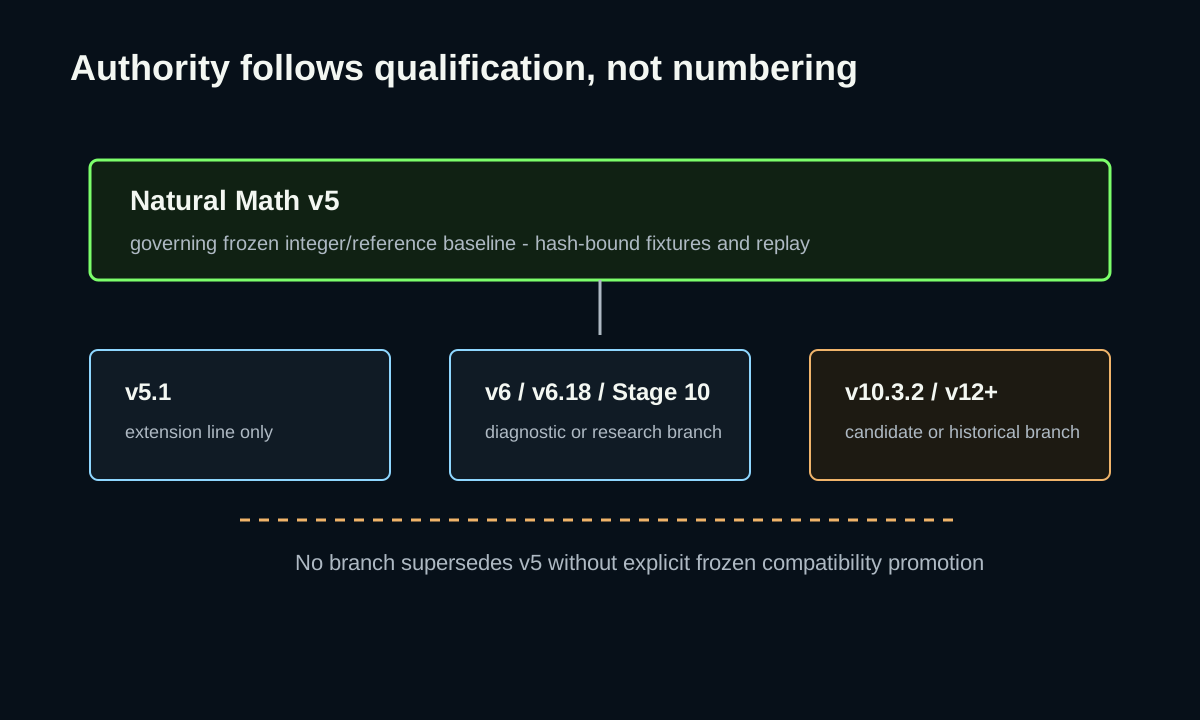
Authority note: Natural Math v5 is the governing frozen integer baseline. Later-numbered diagnostic and experimental branches remain separate unless a versioned, hash-bound qualification record explicitly promotes them.
Version hierarchy
Frozen integer/reference baseline with exact specification hashes, frozen operators, bounded fixtures, and deterministic replay evidence.
Extension line only. It does not silently replace v5.
Later diagnostic or research branches, separately qualified where applicable, not the governing frozen base.
Active or historical research candidates. They do not supersede v5 without an explicit frozen compatibility decision.
Frozen v5 evidence
Integer division, squared grid distance, energy deficit, exact-rational gradient, pressure projection, action selection, movement conflict resolution, bifurcation, bonding, cluster stepping, seeded randomness, serialization, and default parameters are bound to CLAIM-0001 through CLAIM-0013.
Natural Math v5 passed 40/40 frozen oracle fixtures and 210/210 replay configurations in the 2026-07-23 read-only rerun. Claim: CLAIM-0014.
The result is deterministic software behavior under declared integer parameters and fixtures. It is not a general law of biology, physics, intelligence, or morphology.
Applied experiments
Playable applied development · Led by Melissa Ellen Clow
Eracii Arena translates selected Natural Math design principles into a playable deterministic strategy system. Two legends act within a finite grid, bounded rounds, explicit resources, local movement constraints, persistent positional consequences, and exact action resolution.
Once the combatants and player decisions are fixed, match outcomes arise from declared rules rather than random rolls or hidden outcome modifiers. The game also exposes the rival's current planned action and records a chained match history, making decisions and consequences inspectable rather than opaque.
Eracii is an independent applied-development lane. It is informed by Natural Math but is not part of the frozen Natural Math v5 conformance or qualification record.
Namespace discipline
| Namespace | States | Boundary |
|---|---|---|
| Natural Math action | EXTEND, SENSE, RESTRICT_DIE | Local process operators in the frozen integer baseline. |
| Cognitive Basin action | EXTEND, HOLD, RETRACT | Governed memory/action posture, not a rewrite of source events. |
| Cognitive Basin evidence | SUPPORTED, UNRESOLVED, CONTRADICTED | Evidence status layer. |
| Specificity posture | OPERATIONAL, CAUTION, CONSTRAINED, CRITICAL, EXCEEDED | Target-contract response, not truth itself. |
A source event may lead to a separate interpretation or governance request, but the original source state is never rewritten into a different namespace.