Structural
Reusable organization, pattern, and dependency.
Specification
The Unified Fractalish Weighting Kernel keeps significance structured: evidence remains immutable, interpretation remains revisable, and task scalars are derived projections rather than replacements for the WeightReceipt.
Status: SPECIFICATION. UFWK remains a specification unless a named implementation says otherwise. Related claims: CLAIM-0024 through CLAIM-0031.
No universal scalar replaces it. Any task scalar is a derived routing projection. Weights are target-relative. Evidence and interpretation remain separate.
Affective-significance is not subjective feeling. High weight is not truth. High weight is not human worth. High novelty is not action authority. Rights do not depend on weight.
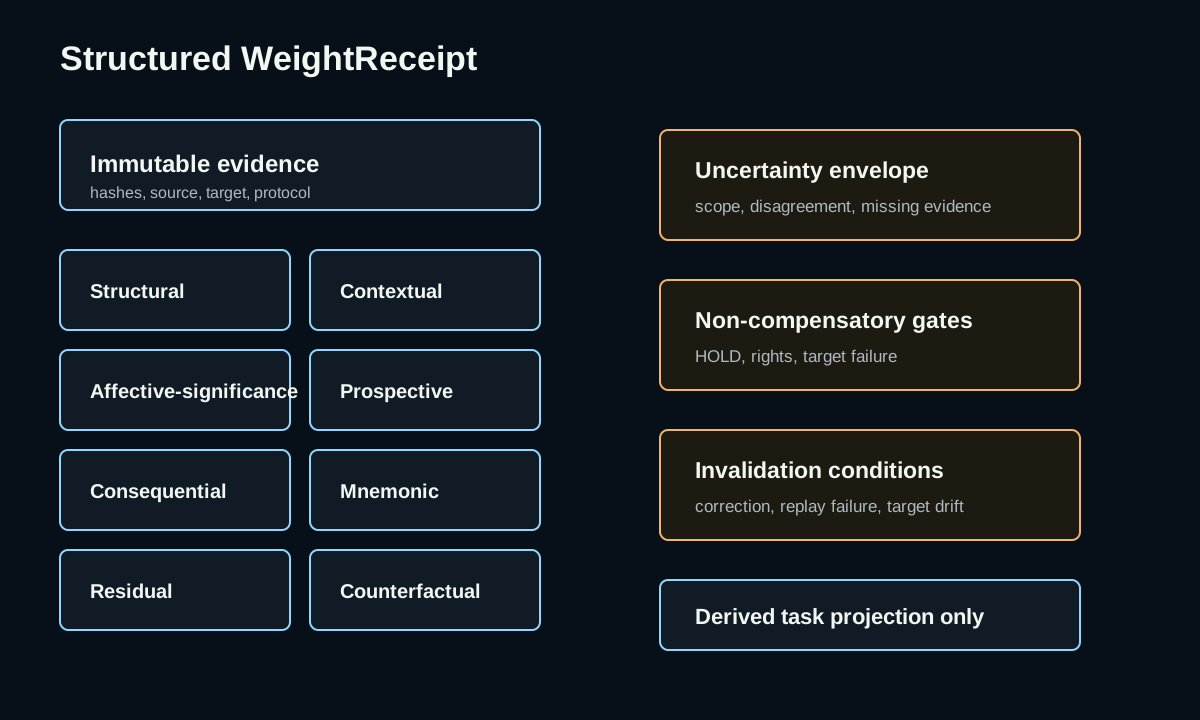
Reusable organization, pattern, and dependency.
Target, role, situation, scope, and protocol dependence.
Attention and mobilization semantics, not subjective feeling.
Future relevance, option value, and anticipated reach.
Effect magnitude, irreversibility, dependency, and harm/benefit accounting.
How memory accessibility, retrieval priority, and replay should change.
What remains outside the fit, including typed residue and uncertainty.
What likely differs under nearby histories, targets, policies, or interventions.
Receipts carry uncertainty, scope, evaluator disagreement, missing evidence, target drift, and calibration limits. Weight inflation is a failure mode, not a success.
Some conditions cannot be compensated by high score: missing authority, unresolved contradiction, rights boundary, target-contract failure, unsafe action request, or replay failure can force HOLD.
Invalidate or supersede a WeightReceipt when evidence identity fails, calibration changes, the target changes, contradiction arrives, replay diverges, or a non-compensatory gate is triggered.
Entroresilience is treated as a provisional directional/accounting extension for consequence and recovery. It is not a completed UFWK runtime.
Hash source evidence separately from later interpretations.
Test target-relative stability across evaluators, tasks, and correction cycles.
Try novelty, urgency, emotional salience, authority impersonation, and consequence exaggeration.
Verify that high novelty or usefulness cannot bypass HOLD, rights boundaries, or missing evidence.
Preserve the original evidence while updating changed accessibility after correction.